
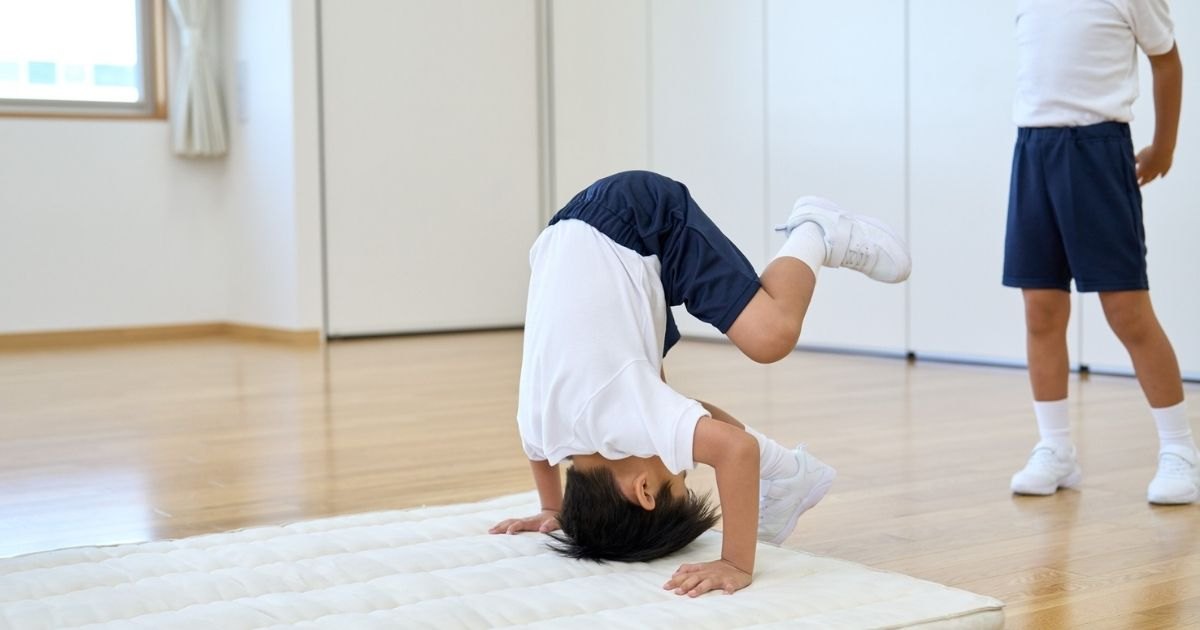
A child stands in front of an obstacle course, a building set or a simple maze and immediately gets started. They jump over the first obstacle, begin building a tower or try random routes. Sometimes it works; sometimes they get stuck quickly. These moments offer a natural way to connect movement with thinking: notice the task, choose an approach, try it and adjust it based on the result.
For children aged 7 to 9, planning does not have to be complicated. A short pause before starting and a few questions can help them think about direction, the order of steps and possible obstacles. The aim is not to slow down every game. It is more useful to help children recognise when a brief plan can save them from repeating attempts that lead nowhere.
A movement task can also be a thinking task
Running, jumping, building and finding your way around do not have to be practised separately from reasoning. When a child tackles an obstacle course, they can choose the order, anticipate the more difficult parts and decide where to slow down. When building a bridge from blocks, they can think about what will support the structure and what to do if it starts to collapse.
These situations are particularly useful because the result is visible. Children can see straight away whether their approach works. Thinking is connected not just to finding the right answer, but also to taking action and seeing its consequences.
A simple cycle: look, plan, try, adjust
You can guide a child through four short steps when working on a practical task. The approach works for movement, building, navigation and creative activities.
- Look: What is the goal, and what might make it harder to reach?
- Plan: What approach will I try first, and in what order?
- Try: I will carry out my plan without expecting it to work the first time.
- Adjust: What worked, what did not, and what will I change next time?
Planning should not take longer than the activity itself. For children, a few seconds or a short conversation is often enough. The aim is to build a habit, not to have a lengthy discussion before every game.
Use an obstacle course to practise choosing an approach
An obstacle course is a good example of a task that naturally combines movement and decision-making. Instead of saying, “Go as fast as you can,” set a different goal: complete the course safely, then see if you can find a way to move through it more smoothly.
Before starting, you could ask:
- Which part will be the hardest?
- Where might it be a good idea to slow down?
- Which obstacle do you need to tackle first?
- What will you do if your first approach does not work?
After the child completes the course, encourage them to say more than just whether they were fast. A brief reflection is more useful: where did the plan work, where did they have to adapt, and what would they do differently next time?
Ask children to identify a structure’s purpose before building
Building sets and blocks often invite children to start putting things together straight away. But sometimes, begin with a question: “What should this structure do?” A bridge needs to connect two places. A tower should stand up. A maze needs a route from start to finish.
Once children have identified the purpose, it is easier for them to see that an idea can look good without actually working. They learn to distinguish appearance from purpose and to look for a specific cause when something goes wrong.
If a bridge collapses, try asking questions instead of giving an immediate solution: “Where did it start to bend?”, “What could you support?” or “Which part do you want to change first?”
Maps teach children to think about direction before speed
Navigation presents a different kind of task. Children need to do more than know where to go. They need to notice landmarks they can use to make decisions: a turn, a set of steps, a tree, a door or another distinctive feature.
You can create a simple route at home or outdoors and ask the child to draw a map. It does not have to be accurate. What matters is that it includes information that will help them find their way later.
Then compare the plan with what happened in practice. Was an important landmark missing from the map? Was one route a dead end? Did remembering the order of places help? This teaches children that a good plan includes the information needed for the next decision, not every detail.
When to let children try and when to step in with a question
If an adult steps in every time something goes wrong, children may not get a chance to adjust their own strategy. But if an adult watches repeated random attempts without responding, children may keep getting stuck in the same approach.
| Situation | A helpful response from an adult |
|---|---|
| The child is trying a new idea | Let them finish the attempt and see what happens |
| They repeat the same mistake without changing anything | Ask what they could adjust |
| They do not know where to start | Help them identify the goal and the first step |
| The task is too easy | Add a constraint or another condition |
| The task is unsafe | Stop the attempt and change the conditions |
This approach balances independence with support. Rather than giving children a ready-made solution, the adult helps them look at the problem again.
A mistake is information, not the end of the task
In movement and building tasks, mistakes are often very concrete: a child takes the wrong turn, a structure tilts, they fail to jump over an obstacle or an object does not work as expected.
Instead of saying “That’s wrong,” describe what happened. For example: “The bridge came apart in the middle,” or “You lost your way at this turn.” These statements give children information they can use.
Then ask: “What will you change next time?” One specific adjustment is often more useful than lots of advice at once.
Speed and careful thinking can work together
Some children jump straight into a task, while others want to plan for a long time. Neither approach is automatically better. What matters is learning to switch between them depending on the situation.
In a safe game, a quick attempt can provide useful information. But if a child is building something more complex, finding their way in an unfamiliar place or has only a limited number of attempts, a short planning pause may be more helpful.
Add constraints that encourage a change of strategy
When a child has mastered a simple version of a task, you do not need to find a completely new activity. Just change one condition.
- For building: use fewer blocks or build a bridge across a wider gap.
- For a route: complete it without returning to a previous spot.
- For obstacles: try a different sequence or carry an object without dropping it.
- For a map: add a new landmark to find along the way.
- For a team task: divide the work so each person handles a different part.
These constraints develop flexibility. Children discover that an approach that worked in one version may not be the best choice when the conditions change.
Working together adds another layer of planning
When two or three children work on a task, having an idea is not enough. They need to explain who will do what and how their steps will fit together. This naturally develops skills that are also useful in later teamwork.
Before building something or setting up a course together, try a brief discussion:
- What are we trying to achieve?
- Who will start, and who will follow?
- When will we pause to check the result?
- What will we do if we disagree?
If one child starts taking charge of everything, you do not have to end the activity straight away. Bring the group back to its agreement and divide decision-making into smaller parts.
A common mistake is praising only the result
When a child builds a tall tower or completes a course quickly, it is natural to praise the result. But if you want to encourage thinking, notice the process too.
You could be more specific: “You noticed the first approach was not working and changed the support,” or “You looked at the route more carefully before your second attempt.” This kind of feedback shows children which decision helped.
It is also worth recognising a good approach when the result is not perfect. That way, children do not come to associate success only with getting it right the first time.
A short practice routine with no special equipment
Everyday situations are enough for practice. Once or twice a week, choose a task that gives the child room to plan and change their approach.
- Choose a task with a clear goal, such as building a bridge, following a route or creating a simple course.
- Before starting, ask the child to describe their first plan in one or two sentences.
- Let them try the plan without correcting them as they go.
- After the attempt, ask what worked and what they would change.
- For the second attempt, ask them to change just one or two things.
- At the end, identify the difference between the first plan and the final solution.
This kind of practice develops more than one specific skill. Over time, children learn a broader approach: understand the task, make a plan, test it through action and use the result to guide the next decision. They can later apply this way of working to learning, team projects and everyday problem-solving.


