
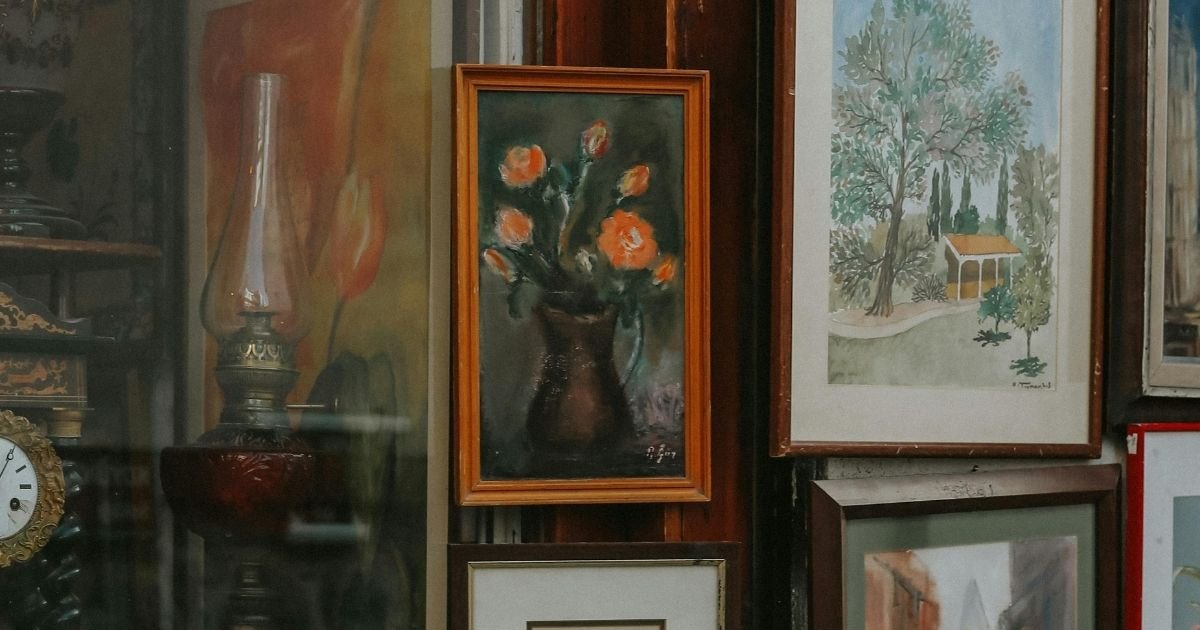
You are looking at a painting made up of dark areas, a few sharp lines and a small patch of light. One person sees a threat, another sees calm after a storm, and a third says the artist intended to depict loneliness. Who is right? People do not have to feel the same thing when they look at a work of art. It is useful, though, to distinguish what the image actually contains, what it makes you feel and what meaning you assign to it.
This kind of distinction is a form of close looking. Instead of sentences, you pay attention to shapes, colours, space, materials and the relationships between them. Critical thinking does not suppress imagination. It helps you explain your interpretation, notice other possibilities and avoid presenting a personal impression as an indisputable fact.
You do not have to guess one correct meaning
Consider two statements. The first is: “This painting makes me feel tense.” The second is: “The artist definitely intended this painting to express fear.” The first describes a reaction you can honestly report. The second makes a claim about someone else’s intention, which you may not be able to determine reliably from colours and shapes alone.
Some works have a clear subject, title and documented historical context. Others leave their meaning open. An open interpretation does not mean every reading is equally convincing. A claim supported by specific details in the image is more plausible than one that ignores visible elements or directly contradicts them.
Four layers for reading an image
Different kinds of thoughts arise almost at once when you look at an image. Separating them briefly can help you see where your conclusion comes from.
- Observation: Name elements another viewer would probably see too, such as three figures, a broken line, a rough surface or a large empty area.
- Personal response: Describe how the scene affects you. You might feel uneasy, curious, light-hearted or repelled. Your feeling is real as an experience, not as a measurement of the image.
- Association: Notice what the work brings to mind. Angled lines might suggest wind, scratched metal or speed. That does not mean the artist intended them to do so.
- Interpretation: Put forward a possible message. Identify which visible details support your reading and which might point to something else.
If you use only the last layer, interpretation can easily run ahead of observation. But if you stick to listing colours and shapes, you miss the chance to use your imagination. The goal is not to leave out any layer, but to move between them consciously.
Five steps for looking at an unfamiliar or abstract work
You can use this approach in a gallery, with an illustration in a book or when discussing an image with friends. You do not need to know art movements or specialist terminology.
- Look before reading the title or explanation. Spend a moment with the work itself. Try to remember its three most striking features. If the title is already visible, keep in mind that it may influence what you see.
- Describe the arrangement. Where is the largest shape? What is in the centre and what is near the edge? Do any lines repeat? Is there space between the elements, or do they overlap? Notice what is missing, too.
- Name your first impression and what supports it. Rather than simply saying the image is sad, try: “It feels lonely to me because the small figure is separated from the other shapes by a large empty area.”
- Come up with a different reading. The same empty space might suggest loneliness, freedom or silence. Find at least one detail that fits your alternative.
- Add context and adjust your level of certainty. Only now read the title, caption or information about how the work was made. Decide whether this context supports, refines or weakens your original reading. If no explanation is available, leave your conclusion open.
You do not have to follow every step when you are simply enjoying art. But if you are using a visual to assess a real-world claim, it is worth slowing down.
The difference between description and assumption
When discussing a work, statements can sound equally convincing even though they express different levels of certainty. This comparison can help you choose more precise words.
| What you say | Type of statement | How to make it more precise |
|---|---|---|
| There are broken black lines in the image. | Observation | Point out their position or direction. |
| The lines feel restless. | Personal impression | Explain what gives you that impression. |
| The lines remind me of shattered glass. | Association | Make clear that you are drawing a comparison. |
| The work expresses fear of change. | Interpretation | Identify the visual evidence and, if relevant, the context. |
| The artist was definitely afraid while making it. | Claim about the artist | Do not treat this as a conclusion without further evidence. |
One image, three possible readings
Example: A small blue boat sits against a large orange area, with several wavy white lines. There is no visible horizon or human figure. You do not yet know the title.
The first viewer says the boat is lost in a dangerous sea. The second sees a journey towards something new. A third person sees only a play of contrasting colours. Each can describe their own response, but these statements are not all the same kind of claim.
The first reading might be supported by the boat’s small size and the vast space around it. But the idea of a dangerous sea is less certain, since the orange area may not represent water. The second reading might come from the direction of the lines, although no destination is visible. The third focuses on formal elements, but that does not rule out a symbolic meaning.
Then you read the title, “Without Shores”. It may draw attention to the open space, but the title alone does not settle whether the image suggests freedom or uncertainty. If the artist had provided a specific explanation, that would give you stronger evidence about their intention. Your own response can still differ from the artist’s intention.
A useful question is not just “What does this image mean?” but also “Which detail led me to this interpretation?” It shifts the conversation from competing over the right answer to comparing what each person has noticed.
Colours, shapes and textures have no fixed emotional dictionary
Red can suggest energy, warning, warmth or celebration. A sharp shape might bring danger to mind, but in another work it could suggest precision or movement. A smooth surface may feel pleasant, yet seem unnatural on an unexpected object. Meaning depends on how the elements work together and on the person looking at them.
So avoid rules such as “blue is always calming” or “dark colours mean sadness”. Even when a colour brings a particular emotion to mind, that is a useful personal observation, not a universal translation. In an illustration, lighting, contrast, the size of areas, neighbouring colours and the subject all matter too.
One useful exercise is to imagine an element in a different arrangement. A small dark circle in the middle of an empty space might feel lonely. The same circle among dozens of similar shapes might look like part of a rhythm. The colour and shape have not changed, but their relationship to their surroundings has.
Visual texture works in a similar way. You might associate rough lines with scratching, or smooth transitions with a hum or silence. Connecting an image with an imagined sound can help you describe your response creatively. It is not proof that the work has a particular sound or that everyone will make the same association.
When intention and credibility matter too
Open interpretation is natural with works of art. But with advertising graphics, illustrative photography or an image accompanying a news story, it may be important to distinguish an artistic impression from a factual claim. A striking composition does not tell you whether its message is true.
Imagine a poster showing a product brightly lit in an otherwise dark room. The image may create a sense of safety and distinction. It does not show that the product actually works better than others. The emotional impact of a visual and evidence about a product are two different things.
When a visual is trying to persuade you, ask three questions: Which elements are leading me to a particular feeling? What specific claim am I being encouraged to accept? Where is the information that could confirm it? You may not need the last question when viewing an artwork, but it can be crucial when a decision has financial or other consequences.
Discussing an image without arguing over one truth
When two people disagree, they may be starting from different places. One relies on personal feeling, another on composition, and a third knows the title or circumstances in which the work was made. It helps when everyone explains which layer their statement comes from.
Instead of saying, “You’re interpreting that incorrectly,” you might ask, “Which detail gave you that impression?” Or: “Can you see anything in the scene that might suggest the opposite meaning?” This is not a test of the other person’s knowledge. It is a way to point out details one of you may have missed.
When looking at a work together, you can divide the task:
- One person describes the image without evaluative words or names for emotions.
- The other person offers two different associations and identifies the details that prompted them.
- Together you distinguish what is visible, what you are assuming and what would require more context.
If you still disagree, you do not have to force your views into one. A conversation is useful if it helps you describe your own thinking more precisely and understand what informs someone else’s view.
A short exercise for the next image you see
Choose an illustration, photograph or abstract work that catches your attention. First, write down three observable details without using words such as sad, beautiful or chaotic. Then note one feeling and one association. Finally, come up with two possible interpretations and give a specific visual reason for each.
After reading the title or explanation, return to your notes. Mark what was supported, what turned out to be only your own assumption and what remains unclear. If no context is available, do not pretend to have reached a final conclusion. Being willing to leave something open is as much a part of reading an image honestly as finding new meanings.


