
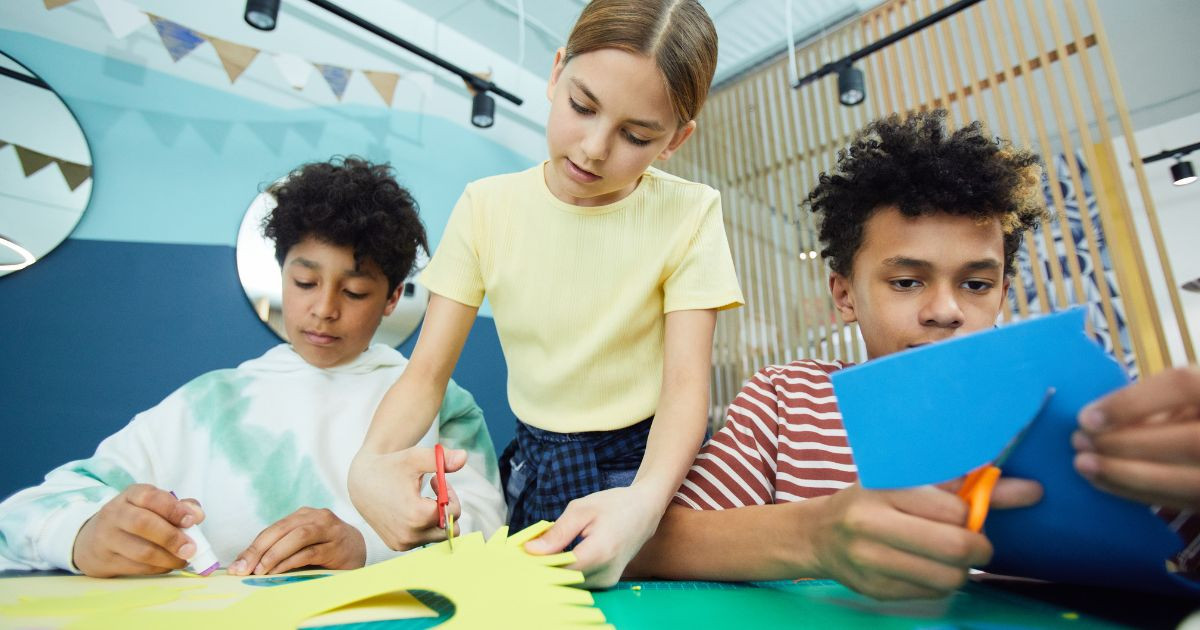
Creativity and imagination are important at ages 7 to 9 because children are developing stronger language, reasoning, and social skills. At this stage, many can think more flexibly, test ideas, and enjoy making things their own. Those abilities do not only support art or play; they also help children solve problems, adapt to change, and work with others.
This matters for school, everyday life, and later personal growth. In a startup or innovation setting, people often need to notice patterns, question assumptions, and build new solutions from limited resources. Children do not need business lessons too early, but they can benefit from experiences that strengthen the habits behind creative thinking: curiosity, persistence, and the confidence to try.
What creativity really means at this age
Creativity is more than drawing well or inventing stories. It includes the ability to combine ideas, make choices, imagine alternatives, and explain a solution. Imagination helps children picture something that is not in front of them yet, while creativity helps them shape that idea into something useful or expressive.
For 7- to 9-year-olds, this often appears in small but meaningful ways: building a different version of a toy, changing the ending of a story, making up rules for a game, or finding an unusual way to solve a puzzle. These moments are worth encouraging because they show children that original thinking has value.
How parents and educators can support creative thinking
- Make room for questions. When children ask “why” or “what if,” answer patiently or help them look for the answer together. The goal is not to have all the answers immediately, but to show that questions are welcome.
- Leave space for open-ended play. Toys that can be used in many ways, such as blocks, craft materials, or simple props, usually support more imagination than toys with only one correct use.
- Use specific praise. Instead of only saying “good job,” notice the process: “You tried three ways to build that tower,” or “I like how you changed the story to make the character solve the problem.” This reinforces effort and experimentation.
- Allow mistakes. Children often become less inventive when they fear being wrong. If a drawing, project, or idea does not work, treat it as part of learning rather than failure.
- Limit over-direction. Helpful guidance is good, but too many instructions can reduce originality. Give a goal, then let the child decide how to approach it when possible.
Practical activities that build imagination
Simple, regular activities are often more effective than occasional “creative exercises.” The aim is to make creative thinking part of everyday life.
Storytelling and story building
Ask a child to tell a story from a picture, a toy, or a random object in the room. You can begin with a prompt such as, “What happened before this?” or “What might happen next?” Storytelling supports language development, sequencing, and original thinking.
Drawing, painting, and sculpting
Art activities help children turn ideas into visible forms. Instead of focusing only on neatness, encourage variety: different colors, shapes, materials, or themes. A child might draw a new animal, design a city, or create a map of an imaginary place.
Building and construction play
LEGO, blocks, cardboard, and reusable materials can support planning and problem-solving. Ask children to build something with a purpose, such as a bridge, a house for a toy, or a machine that could move an object. This kind of play combines imagination with structural thinking.
Role-playing games
Playing shop, doctor, teacher, chef, or explorer helps children try different viewpoints and practice social interaction. Role play is especially useful when children create the rules themselves or add new challenges to the game.
Brainstorming simple ideas
Try short brainstorming sessions around familiar topics: How could we make school mornings easier? What could we do on a rainy day? What new game could we create from these objects? The point is to generate ideas first and judge them later.
Creating an environment that supports creativity
A creative child usually needs both freedom and structure. Too little structure can feel chaotic, while too much can leave no room for exploration. A balanced environment makes creativity easier to practice.
- Keep materials accessible. If possible, store paper, pens, scissors, glue, blocks, and craft supplies where children can reach them safely.
- Protect time for unstructured play. Creative thinking often develops when children are not rushing from one scheduled activity to another.
- Model curiosity. Adults can show creative behavior by asking questions, trying new approaches, and thinking aloud when solving everyday problems.
- Support collaborative projects. Working with siblings, classmates, or friends can help children learn how to share ideas, negotiate, and build on someone else’s suggestion.
Introducing business ideas in a child-friendly way
The original article mentions business concepts, and that can make sense if the goal is to connect creativity with real-world thinking. For this age group, keep it simple and practical. Children can explore ideas such as making something useful, explaining why people might want it, or thinking about how to present it clearly.
For example, a child could design a pretend product and answer a few basic questions: What does it do? Who might like it? How would you describe it? This introduces planning and communication without turning childhood play into adult business training. It is best to keep the activity playful, not pressure-driven.
Common mistakes to avoid
- Focusing only on outcomes. If adults care only about the final drawing, model, or story, children may stop experimenting.
- Comparing children too often. Creativity develops in different ways and at different speeds.
- Correcting every unusual idea. Some ideas will be impractical, but immediate criticism can shut down future expression.
- Equating creativity with talent alone. Creativity is also a habit of thinking, and habits improve with practice.
- Overloading children with activities. A few well-chosen opportunities are usually better than constant organized stimulation.
Conclusion
Helping children ages 7 to 9 develop creativity and imagination is not about producing young entrepreneurs. It is about encouraging flexible thinking, confidence, and the willingness to explore ideas. When adults offer open-ended materials, ask thoughtful questions, and allow room for mistakes, children have more chances to practice original thinking in ways that are natural and enjoyable. Those habits can support learning now and may also help them later when they face more complex problems.


